Do you still need an SDK generator?
In January 2025 I picked Speakeasy to generate
Apideck's SDKs, after
evaluating Speakeasy, Fern and liblab. Twenty months later, two of those belong to Postman,
Speakeasy is busy selling an MCP gateway, and Stainless,
which I didn't evaluate, was sold to Anthropic. A
question I thought was settled is open again: do you still
need an SDK generator?
I had already answered it once. Before Speakeasy, our SDKs
came out of the open-source OpenAPI Generator. We dropped
it for high maintenance overhead and non-idiomatic code.
My answer today is still yes, for the SDKs your customers
import. The harder question is the licence: in 2026 no
generator is free, production-ready and yours to ship
under MIT. OpenAPI Generator is free and permissive, but
you write the gaps yourself.
What happened to the generators
Postman bought
liblab
in November 2025, pitched as part of "an integrated
platform for building AI-ready and agent-enabled
APIs". Eight weeks later, on 8 January, it bought
Fern
and its 200+ customers, Square, Twilio and ElevenLabs
among them.
On 18 May,
Anthropic acquired Stainless,
reportedly for more than $300 million, and wound down every hosted Stainless product, the SDK
generator included. Stainless generated the SDKs of
OpenAI, Google and Cloudflare. They kept the code they had
and lost the service that regenerates it each time their
API changes.
And Speakeasy, our vendor, is already pivoting. It
launched an
MCP Gateway, "the control plane between every AI agent and
every MCP server". Its
pricing page
now shows a single Enterprise tier with
"Tailored" pricing, lists "code mode
efficiency" as a feature, and has no SDK rate card.
Four of the companies that defined SDK generation have
changed hands or direction. Two now belong to Postman, one
was bought by an AI lab and switched off, and the fourth
sells agent infrastructure.
Commoditize the complement
Joel Spolsky explained this in 2002, in
Strategy Letter V: "Smart companies try to commoditize their
products' complements." IBM published the
PC's interfaces so add-in cards got cheap and more
people bought PCs.
Swap the PC for an API. Google and Cloudflare sell API
usage, and the SDK is the complement. Look at what both
did after the Stainless shutdown. On 17 September, Google
and Speakeasy
open-sourced Speakeasy's generator
under AGPL-3.0; Google called closed generators
"unacceptable platform risk". Eleven days later
Cloudflare released
Forge
under Apache 2.0, with the line "You should own your
SDKs, CLIs, and docs". Cloudflare's API has more
than 3,500 operations, and the post is blunt about the
motive: "We built Forge because we needed it
ourselves in order to treat agents as our customers."
Speakeasy's version of the play is open-core. The
generator is public, the commercial licence and the
gateway are what it sells.
Stainless is the odd one. $300 million is not a commodity
price. Anthropic paid for the team and for control, then
took the hosted product away from its competitors.
Where the SDK still wins
Our own traffic first. Apideck processes hundreds of
millions of requests a month, and when I split the traffic
we can attribute by client, almost half of it still comes
through an SDK. The rest is plain HTTP: axios, Go and
Python clients calling the API directly. SDKs kept their
users.
What I can't see is who wrote that plain HTTP. A
coding agent is often in the loop now, and when Claude
Code or Cursor writes an integration, in my experience it
often writes raw calls against the docs. Our logs
can't tell an agent's code from a person's.
Cloudflare can: agents were 25% of Wrangler usage in March
and
48% by September.
The trouble is what agents write. When researchers at TU
Darmstadt
had LLMs write raw HTTP integrations, GPT-4o got 60% of them fully right and the best
open-source model 30%. Between 14% and 39% of the
generated URLs were invalid. Constraining the model to the
API spec removed every invalid URL and raised correctness
by 90% on average. The study had no SDK in it, but a typed
client plus a type checker is that kind of constraint.
Code that looks right still breaks when it runs. In Ant
Group's
Alipay-PIBench, coding agents building payment integrations passed
92.79% of static checks on the basic tasks and 73.16% of
integration tests. Adeel Ali, who founded the SDK
generator APIMatic,
put it well on 5 October: an agent writing from the docs "infers the
API's behaviour afresh on each run, so its results
are probabilistic." A type checker wouldn't have
caught those failures. That's the case for an SDK:
auth, retries and error handling that were tested before
the agent arrived.
Google reached the same conclusion and built it into its
Gemini Docs MCP server, which
"nudges agents toward using the SDKs instead of
hallucinating their own integrations". Some of the plain HTTP half of my traffic may be agents
writing worse integrations than they could.
The options on the table
If Stainless dropped you, or you're starting fresh,
these are the options in October 2026.
Fern, inside Postman. According to
Fern's pricing, SDKs are free in Python and TypeScript up to 200
endpoints. Go, Java, C# or any other language, plus custom
code, webhooks and WebSockets, means Enterprise: "per
SDK, billed annually", no public price.
APIMatic, the generator Ali founded. Its
pricing page
starts at $300 a month per language. All seven languages
means the Business tier, quoted on request and capped at
100 endpoints per API. Beyond a 14-day trial there is no
free tier, and the page mentions no open-source programme.
Speakeasy's open generator. It's free to run,
but read the
licensing policy
before you ship. The generator refuses to run until you
elect a licence for its output. Elect AGPL-3.0 and the
Speakeasy-authored code inside your SDK is AGPL; what
comes only from your OpenAPI document isn't. Elect
commercial and you need a token, and then "your
generated SDK is yours to use, modify, distribute, and
license on your own terms". Those rights are
perpetual for every SDK generated while the plan was
active, so leaving Speakeasy doesn't relicense what
you already shipped. Most public SDKs ship under MIT or
Apache, so most teams still pay. It covers eight SDK
languages plus MCP servers, CLIs and Terraform providers.
Forge. Apache 2.0, no strings. But the
README
is honest: "It's still early-days for Forge and
we're laser focused on the first Forge output, the cf
CLI." For now it looks built for Cloudflare first.
OpenAPI Generator. Free, and the one we left in 2025.
OpenAI generated its Node SDK with it before Stainless,
and
according to Stainless, customers complained about the "painful
experiences".
Just build it. An agent will write you a client in an
afternoon. Keeping it correct across every API change, in
every language, is the actual job, and as Ali says,
"an initial working SDK provides only limited
evidence" of how big that job is. OpenAI found its
hand-built Python SDK "required engineering resources
they didn't have". That's worth it for one
client, in one language, that only you call.
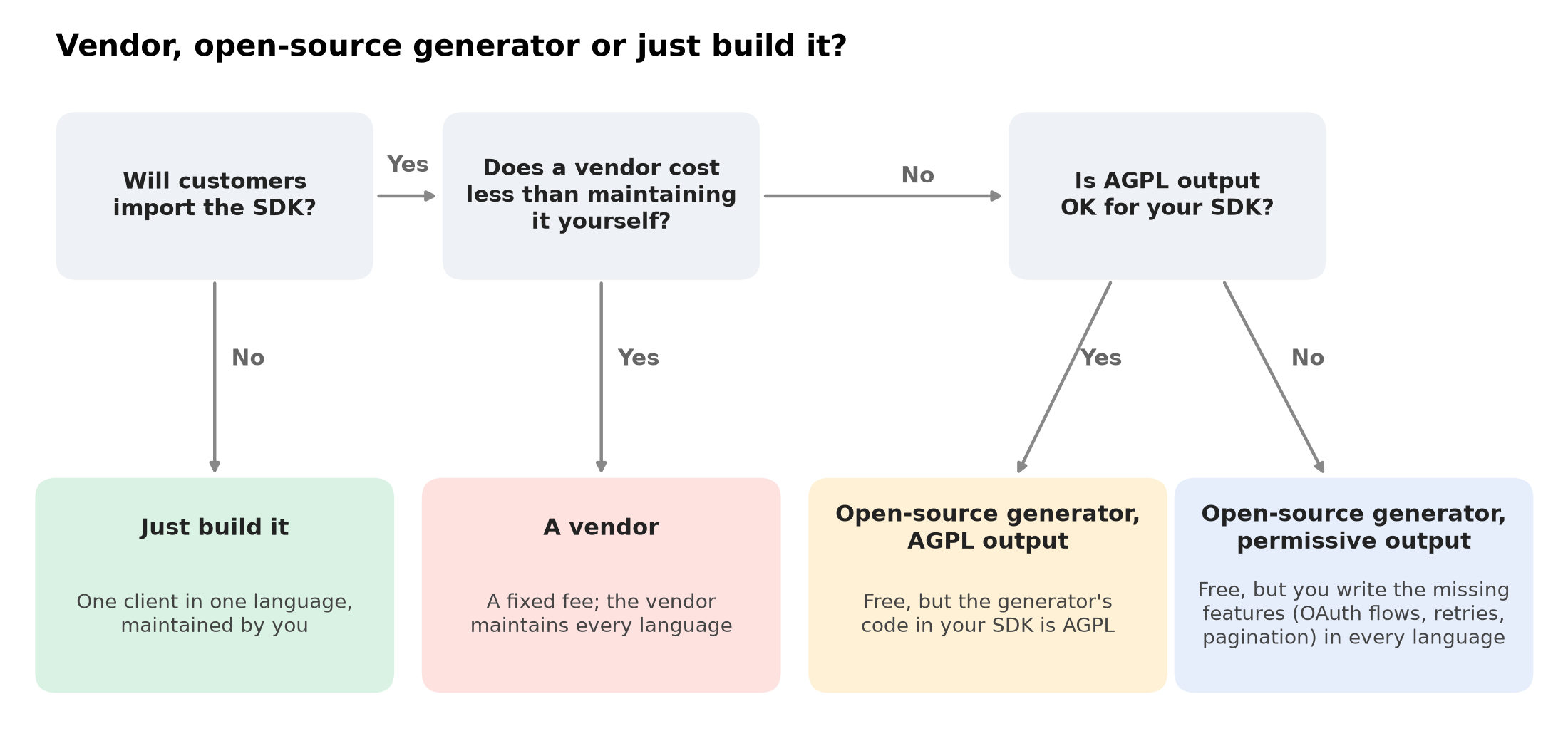
To pick, count the cost of ownership as complexity: the
languages you ship, times the runtime features each one
needs. The features are where cheap generators fall short.
OpenAPI Generator's own
feature table for TypeScript
has no OAuth2 client-credentials flow and no oneOf or
anyOf, and
Speakeasy's comparison
marks it without retries or pagination either. Every
missing feature is code you write and maintain, in every
language.
The vendor's fee is fixed. Your own maintenance grows
with every language, feature and API change. When only you
call the client, there's only one of each.
|
|
Available options - The Weekly Interface Newsletter
|
The gap
One option is missing from that list: a free,
production-ready, multi-language generator whose output
you can license however you want.
Open-source maintainers felt it first. On 19 May, the day
after the Stainless announcement, someone opened
issue #2042
on Speakeasy's repo, asking for a free tier for
open-source projects:
"This leaves a real gap for open-source maintainers
who relied on Stainless for production-quality SDK
generation that includes models, types, resources,
authentication, async, pagination, errors, and retries
without the budget of a commercial API team."
On 11 October Speakeasy closed it as completed. One reply:
"We've since open sourced so this enables
open-source projects to use the generator directly for
free, under AGPL." That fixes the price. The licence
stays: an SDK generated without a commercial plan carries
Speakeasy-authored code under AGPL-3.0, so a maintainer
who wants to ship under MIT or Apache, like most public
SDKs, still needs the commercial token.
The issue also makes a fair business case: Stainless got
its brand from every developer who imported an OpenAI or
Anthropic SDK and traced it back to the toolchain, and
"that flywheel is now unowned". Speakeasy's
AGPL answer is its bid for it, and it works against the
very thing it wants to win, because that flywheel turned
because developers imported those SDKs without thinking
twice, into backends, mobile apps and their own libraries.
Many companies won't let AGPL code in at all:
Google's own
policy
says it "MUST NOT be used at Google", the same
Google that co-released this generator under AGPL. So the
free path produces SDKs that people hesitate to import.
I understand why the licence is where it is: the token is
what Speakeasy's customers, us included, pay for. But
Speakeasy has already told us what generation is worth.
Releasing the generator itself as open source is an
admission that turning an OpenAPI document into a typed
client is no longer a moat. What companies still pay for
is everything after the first generation: keeping SDKs in
step with a changing spec, catching breaking changes
before release, and having someone to call when a
customer's integration breaks. Charging for the
output licence protects the commodity and leaves the
service to sell itself.
There is a well-worn way out. GNU Bison's generated
parsers contain GPL code, and an
explicit exception
lets anyone release that output under any licence. GCC
does the same with its
runtime library exception. Speakeasy could add a similar exception to its
generated code tomorrow and keep the AGPL on the
generator, where it actually protects something. That
would make it the default choice for open-source
maintainers and hand it the flywheel it is bidding for.
Maybe you don't need SDKs at all
Resend's Zeno Rocha
made the case in 2025: "Agents have the power to write their own SDKs if
needed, so SDKs are less important." Agents also use
CLIs (that 48% is Wrangler, a CLI), Cloudflare's
Code Mode
searches the OpenAPI spec directly, and more than half my
own traffic is plain HTTP. Forge compiles an SDK, a CLI
and an MCP server from the same spec. So maybe the spec is
the real contract and the SDK is one output among several.
I agree with half of it. The spec matters more than ever,
because a bad spec now compiles into a bad SDK, a bad CLI
and a bad MCP server at once.
Where I disagree is what happens after the agent leaves.
An agent can write a typed, tested client in an afternoon,
so the expensive part is owning it. A vendor-maintained
SDK is a maintenance cost paid once: the spec changes, the
vendor regenerates, and every customer picks up the fix
with a version bump. An agent-written client is a fork.
Each customer owns its own copy, frozen at the moment it
was written, so one breaking change in the API turns into
a separate incident at every customer, usually found in
production and fixed by a team that didn't write the
code. Agents made writing the code cheap, but the total
cost of ownership didn't go down. It moved from the
vendor to every one of its customers.
Where I land
Your customers still need SDKs. The integrations they run
for years should sit on a client you maintain once. Keep a
generator for that.
Your agents need something different. They don't need
more code, they need intent: a clear answer to what each
operation is for and when to use it. No generator gives
you that for free. It comes from method names an LLM
guesses right on the first try, a surface cut down to the
operations that matter, descriptions that explain the job
rather than the endpoint, and errors that tell the caller
what to do next. That was my argument in 2025 for human
developers, and agents need it more. For the surfaces
agents call directly, that may mean building your own:
still a generated client, but one where you control every
word the model reads.
Hit reply and tell me: are your integrations still using
SDKs, or has your coding agent quietly stopped importing
them?
Unsubscribe
| 1 Bd des clubs - CFC, 20200 Casablanca, Morocco
|